

Elastic hosting: resources that go up and down when you need them
One thing we have seen from support for years is that people end up choosing a hosting plan for the worst day of the year, which leaves many of them paying for twelve months at the size they really only need for two afternoons of a campaign. It seemed a common enough problem to deserve a different answer, and that is where the Elastic plan comes from.
The idea is simple to explain: resources move. You move them whenever you want, or they move by themselves when your website needs it, and the invoice follows what you actually had rather than what you ordered at the start.
How it works
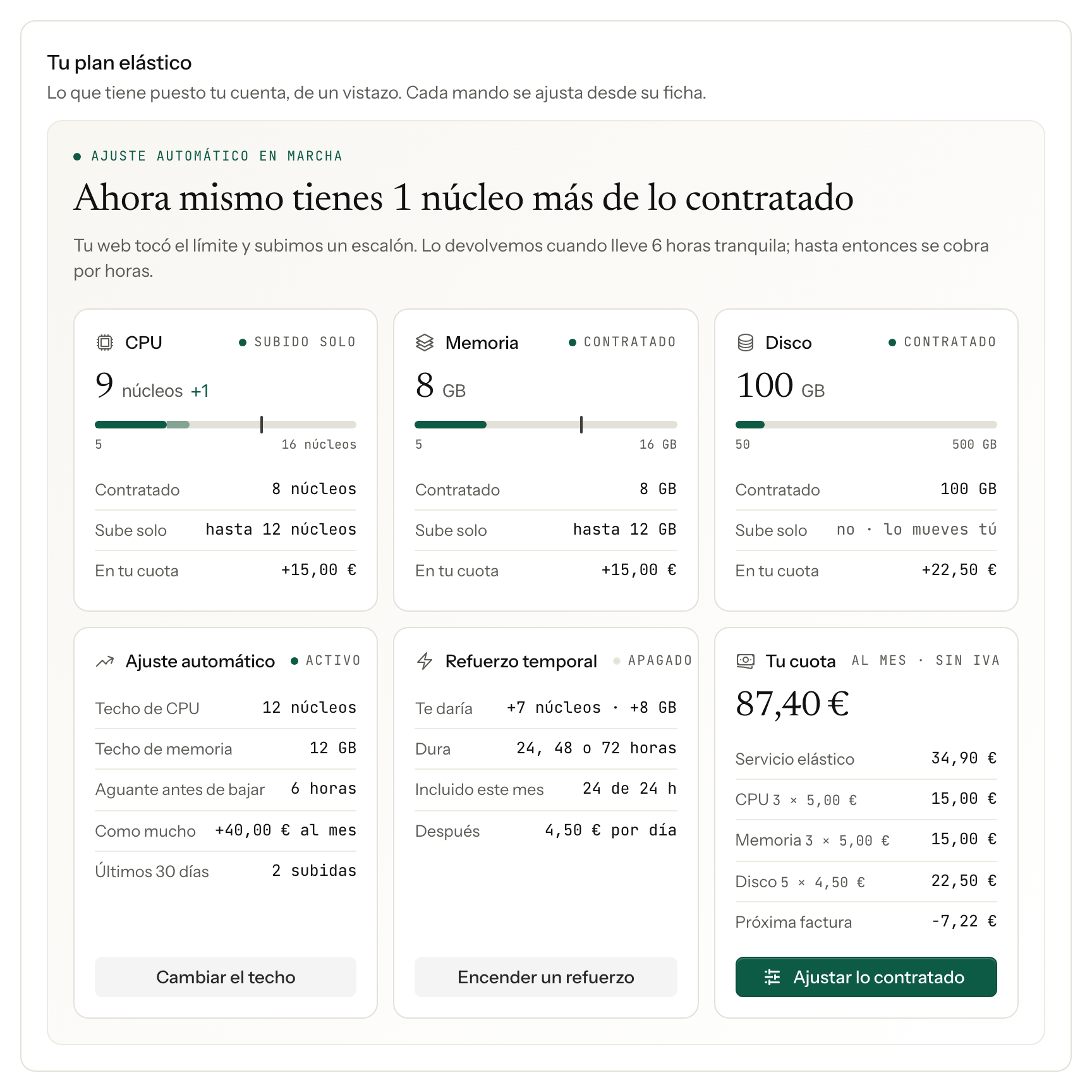
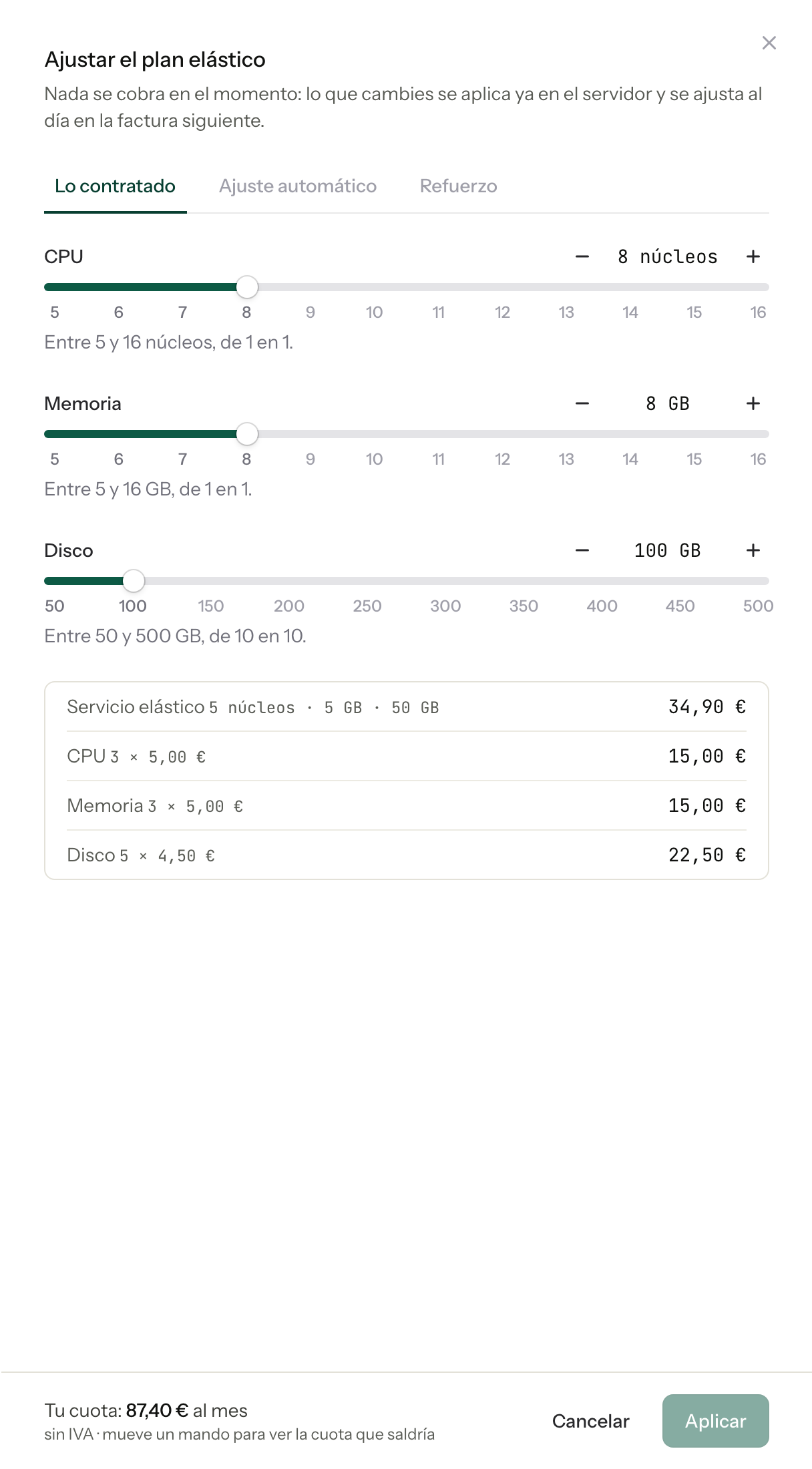
The plan starts from a floor of 500% CPU, 5 GB of RAM and 50 GB of disk, included in the base fee, and from there it goes up and down in steps of one core, one GB of memory or 10 GB of disk at a time, up to a ceiling of 1600% CPU, 16 GB of memory and 500 GB of disk.
There are three things worth understanding well, because they are what make it different from upgrading a traditional plan.
Moving a slider costs you nothing at that moment
When you change a resource, the change is applied on the server instantly and does not go through the payment gateway, so you do not have to confirm any charge for your website to get what it needs. Whatever you had is settled afterwards, on the next invoice, and we do it with a breakdown per resource ("CPU +€2.40, RAM −€1.10") so you can see where each amount comes from without having to trust a total.
Scaling down does not create refunds or one-off credits either: it simply subtracts on that same invoice.
You never pay more than what you actually had
This is the promise that holds everything else up, and we want to put it in writing: having a level for a few hours can never cost you more than that same level for the whole month. If you scale up one afternoon and down at night, you pay for the afternoon.
We designed it this way because we did not want scaling up to be a decision you have to think twice about with a calculator in hand, which is exactly what happens when upgrading a plan ties you into something.
The boost, for the big day
Sometimes what is coming is not growth but a specific spike you know is on its way (a campaign, press coverage, Black Friday). For those days there is the boost: it gives you double the resources for 24, 48 or 72 hours and switches itself off when it expires, without you having to remember anything.
Each month you get 24 hours of boost included in the plan. Longer durations cost €4.50 per extra day, and you see the price before you click, not after. Hours you do not use do not carry over from one month to the next.
And if you would rather not keep an eye on it
You can also leave it to autoscaling, which goes up a step when needed and back down when it is no longer needed. You can turn it off at any time and move the sliders by hand, of course.
What we think is worth explaining is how it decides, because that is where these systems usually fail: it does not look at averages. A website can spend the whole day at 6% of its CPU limit and still be throttled dozens of times during its peak hour; the average will say the plan is more than enough while the client watches their website go down. That is why what we look at is the throttling events: the limit being hit and the process that never got to start. These are real events, and no average hides them.
What it costs
The base fee is €34.90 a month with the whole floor included, and from there €5 per core, €5 per GB of memory and €4.50 per 10 GB of disk. Disk is also tiered, so those who order a lot pay less for the last few GB, simply because they cost us less too.
It is billed monthly only, with no minimum term. That is where the premium for flexibility lies, and that is why we would rather not slip it in later as made-up surcharges elsewhere.
Who it is for, and who it is not for
This plan is designed for projects with spikes: shops with campaigns, media outlets, launches, anything that triples one month and goes back to normal the next.
If your usage is flat, a fixed plan will work out better for you, and we will tell you so ourselves from the panel when we see that is your case. Elasticity comes at a price, and paying for it without using it makes no sense.